
General Information
-
If you are fortunate enough to have any original factory documents with your car you are in the minority. If a car has even one of these documents it raises the desirability and even the value of
-
the car. Only a very small percentage of 1967–1969 Plymouth Barracuda owners are lucky enough
-
to have some of these documents and even fewer have all of these important papers.
-
-
The broadcast sheet, Certicard, window sticker, dealer invoice, owner’s manual, warranty manual,
-
and original receipts are all forms of documentation for these classic cars. Their importance cannot
-
be underestimated when establishing the pedigree and history of your car.
-
-
Always inquire about the original paperwork before purchasing your dream machine. When your car left the dealership the original owner probably had a packet of original paperwork. How many of these documents survived over the years varies.
-
-
This page will help you understand and decode these documents.
Build Record
-
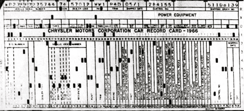
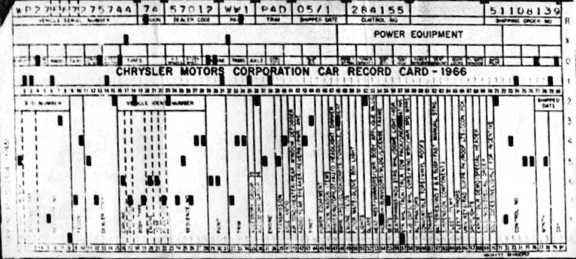
Before your car was built, an order for it was placed with Chrysler. It may have been placed by a buyer, a dealer or out of a sales bank. When the order was made, a Build Record was produced. In 1969, this was an IBM computer punch card.
-
-
-
The Build Record is the beginning seed of your manufactured car. It’s the DNA which contains information about what type of car is going to be built, the body style, paint, options, etc. From the Build Record, several Broadcast Sheets were generated and from that a Fender Tag was stamped. When the order was sent for production (Scheduled Build Date), the Fender Tag and a large, blue-lettered broadcast sheet were attached to the frame on the assembly line. At each specialty shop along the assembly line, another Broadcast Sheet was printed, (up to 12). The Build Record and Broadcast Sheets were usually left in the cars, but not always.
-
The Scheduled Build Date is the first part of the SON (Shipping Order Number) on the body tag. It's not always dead on but in those cases it is close enough- usually just a few days difference.
-
Bill Walsh
-
When the dealer sold the car, the Zone Office made a Build Record on their computer. The original warranty was activated from this. The Build Record was sent back to Chrysler where it was copied to microfilm. Build Records are still on file in Detroit, but many are not.
-
-
If your car is 1967 or younger, you can request the build record from Chrysler. Most after 1967 are not on file. To obtain a copy of your Build Record, send a letter requesting the Build Record to:
-
-
Chrysler LLC
Corporate Historical Collection
12501 Chrysler Fwy.
CIMS 410-11-21
Detroit, MI 48288 USA
Attn: Historical Information -
-
Include the VIN of the car, proof of ownership (a copy of the title), a self-addressed stamped envelope and a check made payable to Chrysler LLC. Check the Chrysler Historical website for current pricing. It used to cost $45. Typical wait time is a couple of weeks. If your build record is not on file, they will return your check.
-
You will receive some interesting information about your car build, options and info about where the cars were originally sold. Note: The quality of a microfilm copy is not great. This is however, an important piece of your Barracuda history.
-
So be sure to look for any scraps of paper that are left in your car when you disassemble it.
Shipping Order
-
A shipping order number is assigned to a car.
-
Then they assigned a Vin number to a car.
-
-
The shipping order number only appears on two pieces of nomenclature that you get with the car:
-
1. fender tag
-
2. build sheet
-
-
On the radiator core support member is a stamped number. It will not match the vin number on the dash. It will match the shipping order number on the fender tag. When it does, that means the core support has not been replaced.
-
-
The shipping order number should also be on the trunk lip (driver side).
-
With both the trunk lip and core support numbers match, you then have a numbers matching body, at least.
-
-
In 1968, that was the last year they put shipping order number on the body panels, not the vin number.
-
In 1969, they put the vin number on the core support. That should match the trunk lip and the dash vin.
Vin Tags
-
The VIN Tag is a metal “vehicle identification number”. It identified the vehicle identification number and the production date. Your vehicle’s VIN tag should also coincide with your broadcast sheet, and several other locations throughout your Chrysler. This label was installed on all cars produced from 1969-1979 (1969 is Daytona only).
-
In 1967 and earlier, the VIN tag was located on the driver side door jamb.
-
In 1968 and thereafter, it was moved to the dash (viewable through the windshield.)
-
It is attached with two special black rosette rivets. These rivets are available today if you need replacements. The dry Chrysler corporation logo found on the plate is also available.
-

-
Inspect the label to ensure it is original (if claimed to be original) there are a few companies that reproduce this type of label. If the label appears to be too "crisp", incorrect text font and/or too perfect it may not be original. Most original tags are not in perfect condition after 35 years.
-
It is a federal offense to transfer the VIN from one car to another, so don’t do it. Some say that it is an offense to remove the plate from the dash for restoration purposes.
Fender Tags (Production Information Tag)
-
From the Build Record, several Broadcast Sheets were generated and from that a Fender Tag was stamped. It served as production information for the assembly line and was attached on most cars before they were even painted.
-
-
This tag represents the main options that the manufacturer had installed on the vehicle. Please keep in mind that all the options are only found on the build sheet. Some production plants like Lynch Road did not typically identify many options on their tag. The Lynch Road assembly plant fender tags included the least information and had a different layout of the codes. They are usually not painted and are natural in appearance because they hung inside the car during painting instead of being attached to the fender. Consequently, they are not bent on the corner and neither attachment screw is painted.
-
-
At most assembly plants this tag was attached to the inside driver-side fender shelf with one screw and then bent up so paint reached under the tag. It was then screwed down with the rear screw. This is the reason the front screw is painted the body color and the rear screw is natural. This factory bend as well as various punched-out inspector marks and additional stamped markings from the top down are found on original tags.
-
-
There are major differences between the pre-1969 fender tags and the 1969 and 1970 tags. On pre-1969 fender tags the VIN does not appear on the tag, but the Shipping Order (SO) number does. This number is on the body of the car instead of on the VIN such as those on the 1969–1970 cars.
-
-
This tag is critical in documenting a numbers-matching car. Most original tags are not in perfect condition after 30 - 40 years. Inspect the fender tag to ensure it is original (if claimed to be original).
-
-
If you have a very rusty fender tag you can remake the tag with enough documentation. There are a few companies that reproduce tags. If a car does not have a fender tag one can be re-created if you have the car’s build sheet. Without the build sheet a correct tag cannot be produced. Typically the reproduction tags are lighter in weight then the original ones. If the tag appears to be too "crisp" and perfect it may not be original. “Fake” tags can be spotted, and a bogus tag usually makes the entire car suspect. If the tag is missing it is preferable to just leave the car without one. But a missing fender tag makes the car worth at least 25 to 40 percent less than the same car with the original tag.
-
Decoding the Fender Tag
-
Use the web fender tag decode at:
-
-
There are typically 4 lines, but a second tag maybe used for more options.
-
-
Here is the breakdown how to read a fender tag: X=letter, #=number
-
-

-
First Line (bottom line)
-
Letter/ Numbers Meaning Examples
-
X## E44
-
E = Engine Option Code E44 = 318 - 2 bbl 230hp
-
-
X## D31
-
D = Transmission Option Code D31 = A904 3-Speed Auto Trans
-
-
Next three sequence are the VIN (Vehicle Identification Number) of car.
-
The Vin on tag should match VIn on dashboard. This was started in 1969.
-
VIN stamped also on radiator core support, under weatherstripping on drivers side trunk extension and maybe other places.
-
1968 and earlier will have VON, not VIN.
-
-
-
Letter/ Numbers Meaning Examples
-
-
XX## BH29
-
First letter = Model B =Plymouth Barracuda Fastback
-
Second Letter = Class H =High
-
2 numbers = body type 29 =2-door sports hardtop
-
-
X#X F9B
-
Next letter =Engine F = V8 318 CID 1-2BBL “LA”
-
Next number =year 9 = 1969
-
Next letter Assembly plant = Belvedere, Michigan
-
-
###### = Sequential car # = 182319
Second Line
-
Letter/ Numbers Meaning Examples
-
X# B5*B5
-
First Letter = Body Color
-
1970 and later paint codes are 3 characters
-
1969 cars paint color have only 2 characters
-
-
Second Letter model year / color B = Blue Fire Poly Metallic
-
Second number = hue 5 = medium hue
-
-
X#X X# = interior trim code H4B B5
-
-
X#X = seat type H4B
-
vinyl bench seat
-
X# = seat color B5
-
B = blue
-
5 = hue medium hue
-
-
X## = Option
-
A22 Elastomeric Colored Front & Rear Bumper Package?
-
-
###### 158110Vehicle Order Number (internal control number)
Third Line
-
A01 B51 G11 G33 L31 M21
-
-
Optional Equipment Codes
-
A01 = Light Package
Fourth Line (top line)
-
Optional Equipment Codes
-
-
Letter/ Numbers Meaning
-
A6 = Console
-
B4 = Bucket Seats
-
-
B51 = Power brakes
-
-
G11 = Tinted Glass
-
G33 = OS LH Remote Standard Mirror
-
-
L31 = Hood/Fender Mounted Turn Signals
-
-
M21 = Roof Drip Rail Mouldings
-
M25 = Drip Rail Mouldings?
-
M31 = Belt Mouldings?
-
M78 = Wheel Lip Mouldings
-
-
R1 = AM Radio
-
R11 = AM Radio
-
-
V78 = V7*69-70 Accent Stripe
-
V5* thru V9* Missing digit represents color choices
-
8 - Delete
-
-
W9 = type of hubcap?
-
-
abc OPTIONS:
-
a6: Console
-
b4: Bucket Seats
-
m6: Driver's Outside Remote Operated Mirror
-
w6: Build to Spec's for Canada
END = End of Tag
Vehicle Body Identification Numbers
-
A body numbers matching vehicle implies that the VIN and/or a combination of the VIN tag and trim numbers match the numbers on the body.
-
-
On the A, B, and E body cars, Chrysler stamped the partial characters of the Vehicle Identification Number (VIN) or Sequence Order (S.O.) in two locations. All years use a combination of characters found on the trim tag and the VIN tag. The numbers at these locations should be identical.
-
The Primary Location is always the radiator upper core support bar. There was not a specific target position just a target location, so the stamp itself can vary in position from one car to another. In general, out Barracudas had the stamp just to the right of the radiator.
-
-
•1963 - 67 A bodies: They have a two digit model year and eight digits from S.O. number on the radiator core support. Example 32 11062059
• 1968 A bodies: They have a single character plant code, single digit model year, single character car model and the S.O. number stamped on the left hand side of the deck lid seal lip. Example: B8L 111331
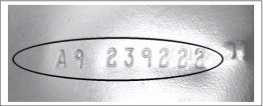
• 1969 -71 A bodies. They have partial VIN stamped on the right hand deck lid seal ledge. Example B3 234450. B=Hamtramck -
-
1969 reference number
Broadcast Sheet (Build Sheet)
-
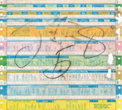
The broadcast sheet, or build sheet, has every part used to manufacture the car. The codes under each option tells everything about the car. Every option is listed on this sheet. This is an important document in validating the vehicle. The fender tag has some of the options listed depending on the plant that built your car, but without the original broadcast sheet many options cannot be proven to be original. You can find lists of these codes in the widely known “White Books” produced by Galen Govier, which can be purchased at a variety of places, including eBay and Mopar shows.
-
-
Assembly line workers used these sheets to determine which parts to install on a specific car. Build sheets changed from year to year and have minor and even major differences in appearance. The codes could indicate different parts in different years. Make sure you are referencing the correct codes for your car’s specific year.
-
-
Each shop had their own broadcast sheet printer. The sheets were printed prior to the car's arrival in that shop so that parts would be in stock, etc. This is why there is sometimes more than one sheet in a car. Maybe the final line shop left one in the seat and the trim shop left one taped to the glove box liner.
-
-
Your car may not have left the factory with a broadcast sheet. Or it may have had more than one. Or it may have had someone else's broadcast sheet. Or your car's broadcast sheet may have been placed in someone else's car. When you do find the build sheet, it is a piece of history of the car.
-
-
Having an original broadcast sheet can add as much as 10% to the price of the vehicle. Inspect the broadcast sheet to ensure it is original (if claimed to be original). Fake broadcast sheets lead to doubt and suspicion, and devalue your car.
-
-
Broadcast Sheet Location
-
Common places to find build sheets are:
-
- rear seat back cushion seat springs
-
- rear seat bottom cushion seat springs
-
- front bucket seat backs seat springs, behind seat back cover
-
- front seat bottom cushion seat springs
-
- under carpet, driver's side in front of the front seat
-
- under carpet, passenger side (Hamtramck cars)
-
- under carpet, rear compartment carpet
-
- under carpet, driver's side rear compartment carpet (St. Louis cars)
-
- taped to top or back of the glove box liner
-
- taped to the heater core under the dash
-
-
Uncommon places to find them are:
-
- in the headliner, driver's seat (St. Louis car)
-
- between gas tank and the rubber gas tank mat (Los Angeles car)
-
-
Keep an eye out for any piece of paper. Wherever you look, don't be disappointed if all you find are scraps. Rodents, insects and mildew destroy build sheets. Save any scraps that may have come from the factory, save them. As an example, a small piece of paper that has "H4B", might be from the trim shop and indicate a part of the car's interior.
-
-
If you find a build sheet that does not belong to your car, don't throw it away. There are several registries that try to unite them with the car owner they belong to. One such registry is at: www.lynchroad.com
Broadcast Sheet Example
-
There is a ‘69 copy on the Moparts Tech Archive.
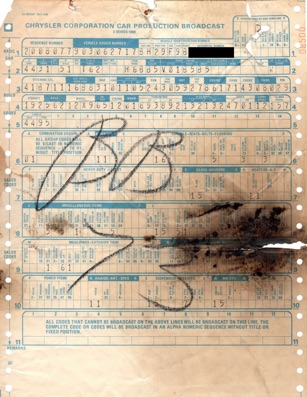
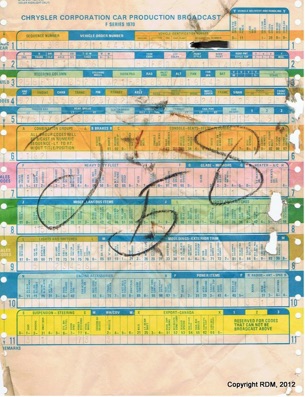
Broadcast Sheet Examples
-
The way to read the broadcast sheet is, the box means "what is in the tach hole in the dash?", and the number tells you if it's a tach, a vac gauge, a clock, or a blanking plate.
-
Max Helm - ’67 Fastback
-
-
7 = 577 Tachometer
-
4 = 574 Vacuum Gauge
-
= clock
-
blank = Filler plate
-
Alan
-
-
In ‘67 if you had an automatic you got the vacuum gauge.
-
In ‘67 if you had a manual you got a tach.
-
You could special order it with the other.
-
-
The Formula-S did NOT include instrumentation, neither the 150 speedo, tach or vacuum gauge.
-
Alan
-
-
The ‘67 Barracuda broadcast sheet under Tachometer is the #577 with a 4 underneath of it. I don't have a tach in my dash but do have the vacuum performance gauge.
-
-
The ‘68 Barracuda broadcast sheet under TACK OR VACUUM has a blank and mine has the blank plate. And it does have TACK, not TACH.
-
Jim Conner - ’68 Cuda
Recreating a Broadcast Sheet
-
Broadcast Sheets of every model year are different. Even the ’69 and ’70 are very different due to different available options.
Blank Broadcast Sheet
-
There just isn’t any reason for it -- except to fake old documents.
-
I added an XL blank sheet to the BOG archive in the files section as BROADCAST SHEET Template.xlsx if you are interested in starting a digital copy. This is not a replica of the original sheet, just a digital copy for convenience. It's close to the sheet for the ‘68, the ‘69 may be different.
-
Jim Conner - ’68 Cuda
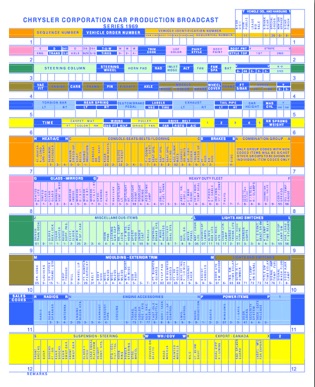
Using Adobe illustrator
-
Scan your sheet and pull it into Adobe Illustrator and recreate all of the lines. The only problem is you have to copy and paste each character on to the sheet.
-
-
You can buy the "Fontself Maker plugin for Illustrator CC" to make a real otf-font out of it. This Plugin is pretty cool!
Using InDesign
-
Another was is to add form fields in InDesign and make the Broadcast sheet a fillable PDF form with the correct font.
Using Photoshop
-
Another way is to scan a original broadcast sheet for your year, load it into Photoshop and copy the numbers (one at a time) and put them in your alterered replica. Use the following techniques:
-
Basic Level Adjustment: Select the whole image. Select the Levels tool. Click on the tiny eyedropper that is filled with white. Then click on an area of brownish background -- you will see the whole page brighten up. Don't worry about the dark areas.
-
-
It is possible that this will be too aggressive considering the pale number text and how dark the brown is. In that case, try Replace Color. Use the eyedropper first on an area of brown. Then adjust the slider at top until it seems to select all of the discolored areas. Then use the sliders at the bottom to adjust brightness until the brown disappears.
-
Max Heim - ’67 FB, ’67 Conv
-
Broadcast Sheet Font
-
The font you guys are looking for came from an old sixties era IBM 407 Accounting Machine.
-
The numbers in the build sheet are also very curious. This also has to be an impact printer of some kind, so these characters are actually cast in metal. What they look like are the letters in punch sets (that you use for stamping labels into metal) — they have the same features. They are also monospaced, and the most distinctive character is the slash through the zero. The numbers 3, 5, 6 and 9 have gentle arcs.
-
Max Heim - ’67 FB, ’67 Conv
-
There is no digital font available. But there might be an AutoCAD font, though.
Certicards
-
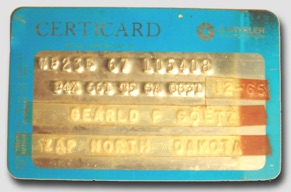
Another important part of your car’s documentation is the Certicard. The CERTICARD identified the vehicle VIN number, select option codes and the original owners name and address and delivery date for warranty purposes. The dealer used this card to help identify the car when it came in for service.
-
-
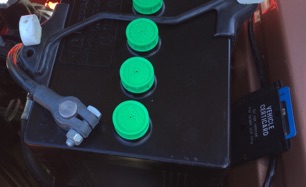
The CERTICARD identification card was initiated in 1965 and ran through 1968. The Certicard came in different forms over these short four years. It evolved from being a plastic card in the glove box, to an aluminum card stored in the engine compartment in a black plastic holder, to a pocket in the back of the owner’s manual for 1968 models. In 1969 this information was hand written in the owner’s manual by the dealer.
-
-
You are very fortunate if this card comes with your car. These cards are often easily lost, particularly with a car that's undergone some repairs or disassembly over the years. It is not often that you find an original vehicle with the correct matching CERTICARD.
-
-
There was two line of specific vehicle information relating to the VIN, S.O., color, interior, trim level, and axle embossed on the card. Starting in 1966 the owners name and address (less zip code) and delivery date was printed on special tape that was applied to the face of the card. The tape was special Chrysler issue semi-clear label that had a Penta-Star on the label. The label was fed through a Dymo type hand help impact label maker. The original label tape was delivered to dealers in a red, white, and blue Chrysler box. The part number for the label tape is 83-100-0250. The holder stated “VEHICLE CERTCARD Do not remove for dealer use only”. Some time in mid-1967 the words "PRINTED IN USA" was added to the bottom of some CERTICARDS.
-
1
-
2
-
In 1968 the CERTICARD storage location was changed from the engine compartment to a special pocket in the back of the owner’s manual. The information that was on the 1968 cards was almost identical to that of the 1966-67 years. This was the last year that the CERTICARDS were used.
-
Monroney Label (window sticker) or Retail Price Label Sticker
-
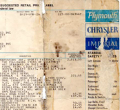
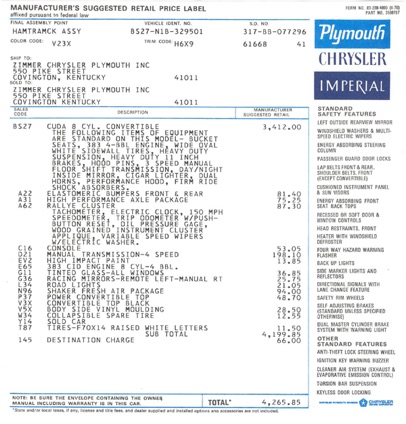
In 1959 a window sticker was required by law to be prominently displayed in the car’s window for the customer to see. The Monroney label details the option of the vehicle thus provides information about the vehicle. The label often lists equipment in groups, such as performance features that include engine, transmission, axle, tires and convenience features, such as power windows and cruise control. The label also details optional equipment and suggested price of each item. Sometimes the options are simply listed as "preferred group" or "light group." After listing standard and optional equipment, the label displays the manufacturer's suggested retail (base) price and then adds the options along with the freight charge to arrive at a total price.
-
-
The label also lists the make, model, year and VIN of the vehicle. Double-check the VIN on the label with the VIN tag to ensure the vehicle matched the label and it has all those items as standard or optional.
-
-
-
-
If you are fortunate enough to have the original dealer invoice for your car you can learn important dealer information from it. An original window sticker is often lost. Inspect the window sticker to ensure it is original (if claimed to be original). There are a few companies that reproduce this sticker.
-
If the sticker appears to be too "nice" and perfect it may not be original. Most original labels are not in perfect condition after 30 - 40 years.
Window Sticker Font
-
On the window sticker, it’s a electronic typewriter font (like an IBM Selectric), from a computer impact printer. So it’s a monospaced font, like a typewriter (meaning every character prints the same width, so columns of letters line up).
-
-
It’s a sans serif font, but it has serifs on the numeral 1 (not uncommon) and the capital I. It has straight strokes on the 6 and the 9 (not “hooks”), a curved stroke on the 7, and an open top on the numeral 4 (rare).
-
-
Exact Digital Fonts are not available. The closest things are OCR B, and PT Mono, but both have some incorrect characters. And to look correct, you would probably have to bitmap the entire text block and blur it slightly, so it resembles the fuzzy impact printer output.
Warranty (Maintenance Services)
-
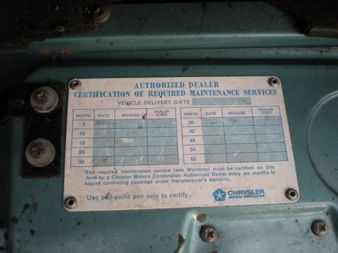
This placard was located in the glove box and was riveted in place. It was in the ’67 year car. ’69 cars do not have this.
-
Vehicle Traveler Sheet
-
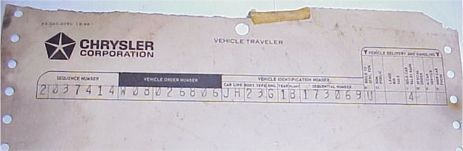
The top of the travelers sheet looks just like the top of the broadcast sheet - but there is something a bit different. The first three numbers of the Vehicle Order Number is typically the Scheduled Production Date - three numbers - the first number is the month - 1 is Jan, 2 is Feb......A is Oct, B is Nov, C is Dec - and the next two numbers are the day of the month. What's interesting is that on the traveler's sheet, its W08 - hmmm. No W month. So its either a misprint or means something slightly different.
-
-
-
-
Quality Assured Sticker
-
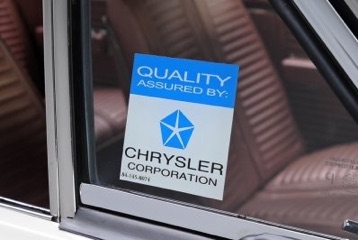
This sticker was delivered by the factory on Chrysler cars from the 60's. It was put on the wing window. This sticker was removed by the dealer prior to delivery to the customer so they are pretty rare.
-
-
-
Motor Vehicle Record
-
To obtain a Motor Vehicle Record Contact you're the Department of Motor Vehicle of your state and make a formal request. This service and fee's varies between states. Some states maintain records longer for longer periods then others.
How to Request Records
-
Records may be researched by VIN, Name, Title Number and License Plate Number.
Request may only be accepted in writing, by FAX and in person. Payment required prior to release of information. -
-
The Federal Driver's Privacy Protection Act, Pub. No. 106-69, }350(b) or 18 U.S.C. 2721 prohibits the disclosure of personal information about any individual from a motor vehicle record to the general public without written consent of the person to whom the information pertains.
-
Personal information of motor vehicle records may be released under provisions as outlined under the Federal Driver's Privacy Protection Act.
Typical Services Available Vehicle Histories
Title Research Registration Research Owner Name Research Bonded Certificates of Title
Typical Fees
-
Fee's vary by state. Some states charge per title found or per 15 minutes of searching. Typical fee's for 5-6 titles, if available, range between $ 15 - 25.00. If no record are found there is typically no charge.
Vehicle Histories
Title Research Registration Research Owner Name Research Bonded Certificates of Title